
Beyond Translation: Why Vertically Specialized LSPs Get Higher Multiples
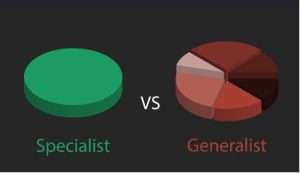
If you’ve spent any time in the language services industry over the past few years, you’ve likely noticed a clear trend: buyers are becoming increasingly selective.
The days when “we translate into 100 languages” was enough to stand out are fading. Today’s buyers are looking for something much harder to build—and much more difficult to replace: specialization.
At Language Transactions, we see this repeatedly in conversations with strategic buyers, private equity firms, and entrepreneurs seeking acquisitions. Companies with a clear vertical focus are easier to understand, easier to position, and often more difficult to replicate than generalist providers.
Why Buyers Value Specialization
Vertically specialized LSPs offer far more than language expertise. They bring industry knowledge, established terminology, trusted client relationships, and operational processes that may have taken years—or even decades—to develop.
Buyers consistently recognize the value of companies that offer:
A legal translation provider trusted by leading law firms tells a very different story from a generalist agency competing primarily on price. The same is true for a life sciences specialist, a government contractor, a gaming localization company, or an interpreting provider with deep expertise in healthcare, the public sector, or ASL assignments.
Vertical Expertise Creates Defensibility
When buyers evaluate acquisition opportunities, they are not simply acquiring revenue—they are acquiring market position.
Consider two companies with similar financial performance. One serves dozens of unrelated industries with little differentiation. The other has built a dominant reputation within financial services, supporting regulated institutions with highly specialized workflows, compliance requirements, and long-standing client relationships.
Even if both businesses generate similar revenue and profitability, the second company often represents a stronger strategic acquisition because its expertise is much harder to replicate.
Technology can be purchased.
Sales teams can be hired.
Language pairs can be added.
But trust, reputation, sector knowledge, and years of industry experience cannot be created overnight.
That is where specialization becomes a competitive advantage.
Regional Focus Can Increase Strategic Value
Industry specialization becomes even more compelling when combined with a strong geographic presence.
Many of the buyers we work with are not simply looking for a specialized LSP—they’re looking for one in a specific country or region.
For example, they may be seeking:
In many cases, buyers are looking to strengthen an existing market position or establish a presence in a new geography. Acquiring a company with local expertise, an established client base, and a respected reputation can accelerate that strategy far more effectively than building those capabilities organically.
What This Means for Sellers
If you’re considering selling your business over the next few years, ask yourself one simple question:
What are we truly known for?
The strongest acquisition candidates are rarely those trying to be everything to everyone. Instead, they are known for solving specific problems exceptionally well within clearly defined markets.
That doesn’t mean a generalist LSP cannot be successful. It simply means that businesses with a well-defined specialization often tell a stronger story to buyers and may attract broader strategic interest.
If your company has developed deep expertise in a particular industry, built long-standing client relationships, and established a strong reputation within a specific market, those strengths deserve to be highlighted throughout the sale process.
Final Thoughts
Specialization alone does not determine valuation. Financial performance, management depth, client concentration, and growth potential all remain important.
However, companies with a clearly defined vertical focus often stand out because buyers immediately understand where they fit within their acquisition strategy and why their capabilities would be difficult to replicate.
In today’s market, clarity of positioning has become a competitive advantage.
| Curious how your vertical impacts valuation? Ask Language Transactions for a confidential vertical-valuation breakdown and a discussion of how buyers may view your client mix, service profile, geography, and market position. |
Dee Johnson,
July 2026
Language Transactions, LLC specializes exclusively in mergers and acquisitions within the global language services industry and draws on experience from more than 40 completed transactions.